Selecting Steels, Titanium & Surface Coatings for High-Speed Motor Shafts
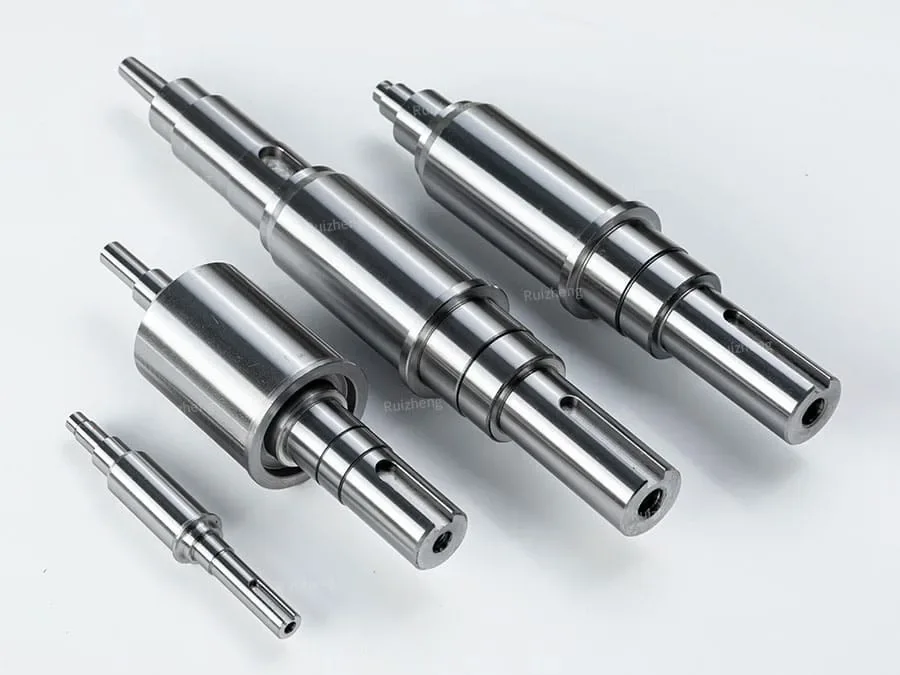
When you're sourcing a custom motor shaft for high-speed applications, the material and coating choices you make early in the design phase will determine whether the shaft survives 20,000 hours or fails in the first month. This guide cuts through the marketing claims and gives you the engineering facts you need to specify steels, titanium alloys, and surface treatments that actually work at 30,000 RPM and beyond.
Steel Selection: Beyond the Datasheet
Most high-speed motor shafts start with a simple question: carbon steel, alloy steel, or something more exotic? The answer depends on three factors—your speed, your load profile, and your budget. Don't let anyone tell you there's a single "best" steel.
For general-purpose servo motors running under 10,000 RPM, medium-carbon steels like 1045 or 4140 are workhorses. They machine well, respond predictably to heat treatment, and keep costs sane. But push them past 15,000 RPM and you'll start seeing deflection issues. That's where alloy steels with higher hardenability earn their keep.
Consider 4340. It's a nickel-chromium-molybdenum alloy that delivers excellent toughness and fatigue resistance after quenching and tempering. For high-speed motor shafts in EV traction motors or industrial compressors, 4340 is often the default choice. It holds dimensional stability during grinding and resists the micro-cracking that kills lesser steels at high cyclic loads.
Bearing steel—typically 52100 or its equivalents—deserves mention for shafts that integrate bearing races directly. You get through-hardening capability and exceptional wear resistance. The trade-off? It's less forgiving during machining, so you'll want a supplier with experience grinding bearing-grade surfaces to Ra 0.1 and holding roundness to 0.001 mm.
Stainless steels like 17-4PH or 316L enter the picture when corrosion resistance matters—think hydrogen energy motor shafts exposed to humid or chemically active environments. 17-4PH offers a good balance of strength and corrosion resistance after aging, though it's not a drop-in replacement for 4340 in pure fatigue applications.
Titanium Alloys: When Weight Trumps All
Titanium alloys, particularly Ti-6Al-4V (Grade 5), show up in high-speed motor shafts when every gram counts. Aerospace and high-performance automotive engineers love the strength-to-weight ratio—roughly 40% lighter than steel for comparable strength. But titanium brings its own set of headaches.
Machining titanium is slow. It work-hardens aggressively, conducts heat poorly, and eats tooling for breakfast. A custom motor shaft in Ti-6Al-4V might cost three to five times more than the same shaft in 4340, and lead times stretch accordingly. You'll also need to account for its lower modulus of elasticity—about 55% that of steel—which means more deflection under the same load. That's a critical consideration for high-speed rotors where critical speed margins are tight.
Where titanium shines is in applications where you can't afford the mass. Say you're designing a high-speed motor shaft for a hydrogen recirculation blower. The lower inertia improves transient response, and the corrosion resistance handles the humid gas environment. Just don't expect to hold the same interference fits you'd use with steel—titanium's thermal expansion coefficient is lower, and its galling tendency demands careful surface treatment or lubrication.
One more thing: titanium's fatigue strength is excellent, but it's notch-sensitive. Sharp corners, undercuts, or poor surface finish will kill you. That's why titanium shafts demand rigorous grinding and polishing—Ra 0.1 or better on critical diameters is not optional.
Surface Coatings: DLC vs. Nitriding vs. Hard Chrome
Coatings are where many designs succeed or fail. You're trying to reduce friction, improve wear resistance, or prevent corrosion—sometimes all three. Here's how the main options stack up.
Nitriding is a diffusion process that introduces nitrogen into the steel surface, creating a hard case (typically 50-70 HRC) without the dimensional distortion of through-hardening. For high-speed motor shafts, gas nitriding or plasma nitriding can extend fatigue life by putting the surface in compression. It's particularly effective on alloy steels like 4340 or 4140. The case depth ranges from 0.1 to 0.5 mm depending on time and temperature. One caveat: nitriding slightly increases dimensions (typically 0.5-1.5 μm per surface), so you'll need to account for that in your grinding allowance.
DLC (Diamond-Like Carbon) coatings are amorphous carbon films that offer extremely low friction coefficients (0.1-0.2 against steel) and high hardness (up to 3000 HV). They're applied via PVD or PACVD at relatively low temperatures (under 200°C), so they don't affect the substrate's heat treatment. For motor shafts, DLC shines in applications where you need to reduce parasitic drag or prevent wear at bearing interfaces. But DLC is thin—typically 1-5 μm—and it doesn't like high point loads. It's not a replacement for a hardened surface; it's a friction modifier.
Hard chrome plating remains a staple for corrosion resistance and wear improvement. It's electrodeposited, typically 10-50 μm thick, and can be ground and polished to Ra 0.05 or better. Hard chrome is great for shafts that see sliding contact or need protection from mild chemicals. It's less effective in pure rolling fatigue applications, where its limited thickness and potential for micro-cracking can be a liability.
| Coating | Thickness | Hardness | Friction Coefficient | Best For |
|---|---|---|---|---|
| Nitriding | 0.1–0.5 mm (case) | 50–70 HRC | 0.4–0.6 | Fatigue resistance, wear resistance on alloy steels |
| DLC | 1–5 μm | 1500–3000 HV | 0.1–0.2 | Low friction, reduced drag, light wear protection |
| Hard Chrome | 10–50 μm | 65–70 HRC | 0.2–0.3 | Corrosion resistance, sliding wear, salvage of worn parts |
Balancing Act: How Material and Coating Affect Rotor Dynamics
High-speed motor shafts live or die by their balance quality. A shaft that's perfectly balanced at 5,000 RPM can shake itself apart at 25,000 RPM if the material distribution isn't controlled. Coating thickness variations, material density differences, and even grinding stock removal can shift the center of mass.
This is where your supplier's process control matters. At our factory, we balance high-speed motor shafts to G0.4 or better—that's a level of precision that requires a constant-temperature workshop and meticulous material traceability. If you're specifying a custom motor shaft for a high-speed application, ask about the balancing grade and the measurement equipment. A ZEISS CMM with 0.5 μm resolution is table stakes for verifying geometry, but dynamic balancing needs a dedicated balancer that can spin the part at speed.
Material choice influences balance in subtle ways. Titanium's lower density means less mass to balance, but it also means the shaft is more sensitive to coating thickness variations. Nitrided cases add mass uniformly, so they're less of an issue. DLC, being so thin, has negligible effect. Hard chrome can introduce imbalance if the plating is uneven—another reason to work with a supplier who grinds after plating.
Practical Selection Flowchart: From Application to Specification
Start with your operating speed and load. If you're under 15,000 RPM and moderate loads, 4140 or 4340 with nitriding will cover most needs. The nitrided case gives you wear resistance at bearing seats and seal journals, while the tough core handles bending fatigue.
Push past 20,000 RPM and you need to think harder about inertia and critical speed. Here, a titanium shaft might make sense if weight reduction is critical, but you'll pay for it in machining cost and lead time. Alternatively, a hollow 4340 shaft with a nitrided surface can achieve similar inertia reduction with better stiffness and lower cost.
For corrosive environments—hydrogen motor shafts, for instance—consider 17-4PH stainless with a DLC coating on sliding surfaces. The DLC provides a low-friction, chemically inert layer that protects the stainless substrate from galling and wear.
Don't overlook the grinding and QC steps. A custom motor shaft is only as good as its final grind. We hold outer diameter tolerances to ±0.003 mm and roundness to 0.001 mm on high-speed motor shafts, but those numbers require the right grinding wheels, coolant, and temperature control. If your supplier can't document their grinding parameters and inspection results, look elsewhere.
For hydrogen energy motor shafts, the stakes are even higher. Hydrogen embrittlement can turn a high-strength steel into a brittle failure waiting to happen. That's why we recommend careful material selection and post-processing—nitriding can actually help by putting the surface in compression, but you need to avoid plating processes that introduce hydrogen. Our hydrogen energy motor shaft page covers these considerations in more detail.
And if you're designing a high-speed motor shaft for a machine tool spindle or a high-performance servo, check our high-speed motor shaft specifications for baseline tolerances and material options. We've built these shafts in alloy steel, stainless, and titanium, and we can advise on the trade-offs.
Quality Control: The Hidden Variable in Material Performance
You can specify the perfect steel and coating, but if the grinding and inspection aren't up to par, you'll never see the performance you designed for. That's why we emphasize process control at every step. Our constant-temperature workshop keeps thermal expansion in check during fine grinding. Our ZEISS CMM verifies dimensions to 0.5 μm, and our Mitutoyo roundness testers confirm that critical journals are truly round—not just within tolerance on average.
For high-speed motor shafts, we also perform dynamic balancing to G0.4 and can provide certification. And because we're ISO 9001:2015 certified and SGS verified, you get traceability from raw material to finished part. If you want to dig into our grinding and QC capabilities, our grinding QC page lays out the equipment and tolerances we hold.
One more practical tip: involve your supplier early. If you're considering a titanium shaft with DLC, talk to us about machinability and coating adhesion before you finalize the design. A small change in fillet radius or surface finish spec can save you weeks of lead time and thousands in cost.
Frequently Asked Questions
What's the maximum operating speed for a nitrided 4340 motor shaft?
Speed limits depend on geometry, bearing selection, and balance quality, not just material. A well-balanced 4340 shaft with nitrided journals can run at 30,000 RPM or higher in the right application. The nitriding actually improves fatigue resistance at speed. But you must balance to G0.4 or better and ensure the critical speed margin is at least 20% above operating speed.
Can DLC coating be applied to titanium motor shafts?
Yes, DLC adheres well to titanium alloys, but surface preparation is critical. Titanium's oxide layer must be removed immediately before coating, and a thin adhesion layer (like chromium or titanium nitride) is often used. We've applied DLC to Ti-6Al-4V shafts for low-friction applications, but it's not a cure-all—titanium's low thermal conductivity means you need to manage heat during operation.
How do I choose between hard chrome and nitriding for corrosion resistance?
Hard chrome offers better corrosion resistance in most environments because it's a barrier coating. Nitriding is a diffusion process that doesn't add a protective layer—it hardens the surface but leaves it susceptible to rust unless you post-oxidize or paint. For shafts exposed to moisture or chemicals, hard chrome or a stainless substrate with DLC is usually the better bet. For wear resistance in oil-lubricated environments, nitriding wins.
Need a Drawing Review or Sample Quote?
Manufactured directly by Foshan Ruizheng Machinery Manufacturing Co., Ltd. in our ISO 9001:2015 certified, temperature-controlled Foshan, China facility with 70+ CNC turning, milling, and grinding machines and German ZEISS CMM inspection.
Send 2D/3D Drawings for Quote